
WELCOME
Hello there.
We hope that you're doing well and enjoying the summer, in spite of the heatwave!
Whether you are planning a grant application, exploring AI adoption or testing a new product idea, the challenge is rarely a lack of information. It is knowing what evidence matters, what assumptions need testing and where to focus next.
In this issue, we share our new AI Ecology playbook, early access to Juno and Theia, useful funding opportunities and the AI updates we think are worth paying attention to.
If you have any questions or want to reach out to collaborate, get in touch.
Chloe and Simon (and Milo)
CO-FOUNDERS, SHARP INSIGHTS
GETTING INVOLVED IN LOCAL EVENTS
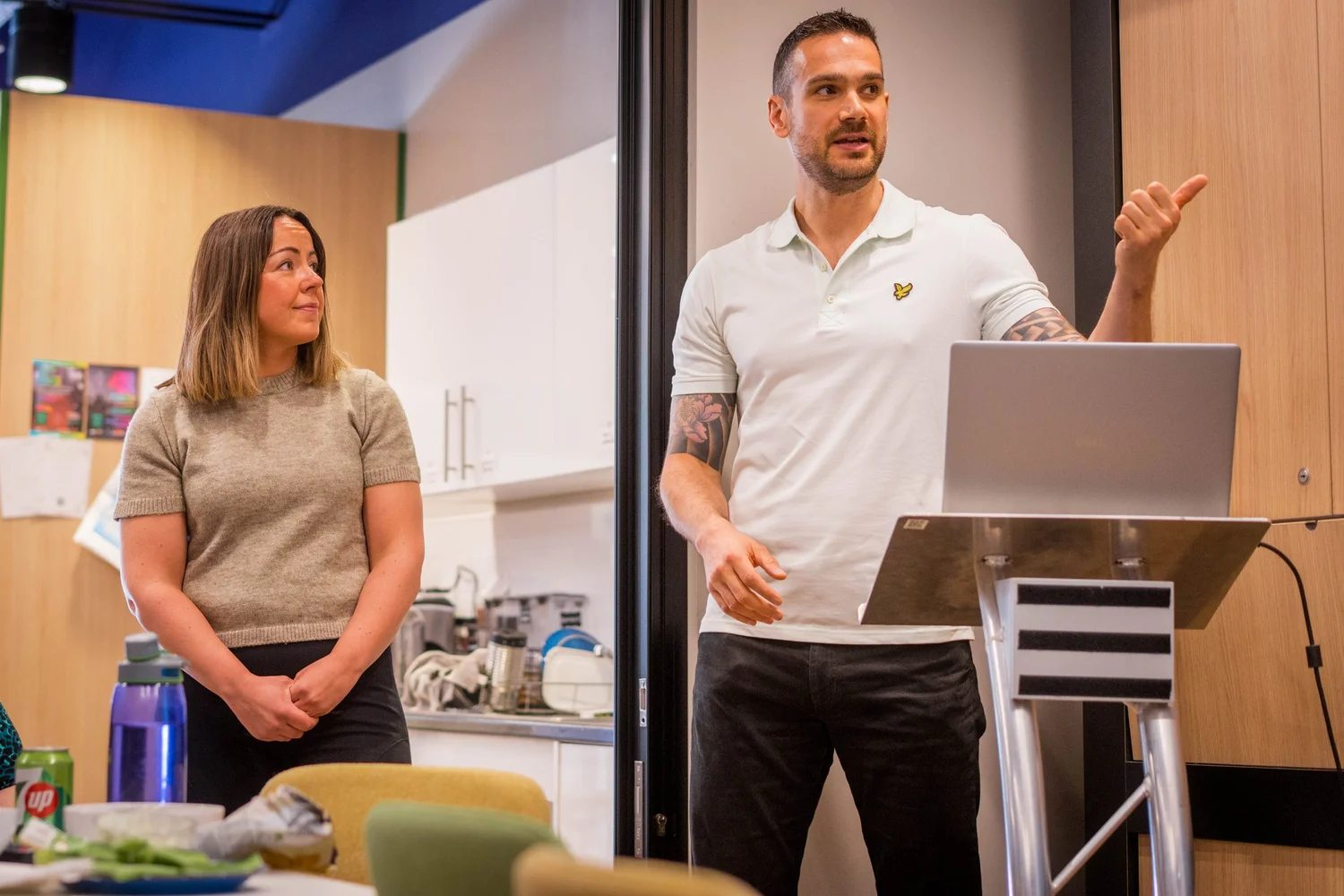
We've spent the last few weeks going to and speaking at Milton Keynes events, including South Midlands Growth Hub Finance Panel, Cranfield University's Venture Day, NatWest Accelerator, BizTech, Expo MK and Accelerating AI Conference.
Across the events we attended and spoke at this month, one theme kept coming up: the right funding route depends on the stage of the business and the evidence behind the opportunity.
A founder looking for grant funding, debt finance or VC investment is making a strategic decision about what kind of evidence they need, how much risk they can carry and what story they need others to believe.
The strongest businesses were the ones starting with the customer problem first, then working backwards to the right funding, product and growth strategy.
Thanks to Justin Goh for the photo.
WHAT WE'VE BEEN DELIVERING
This month we also delivered sessions for:
Digital Boost: A Beginner's Guide to Innovate UK Grants. If you're a Digital Boost member, you can watch the replay here.
Female Product Lead: Reframing Belonging. You can see our blog post about it here and see the session here.
The common thread across both sessions was that good strategy is never just about the right answer. It is about understanding the people, politics, incentives and evidence that shape whether an idea gets funded, adopted or acted on.
THINKING ABOUT AI DIFFERENTLY
AI Ecology
The AI Ecology Playbook introduces a different way of approaching AI adoption. Which is not as a technology rollout, but as an ecosystem that grows over time.
Inside you'll discover:
- The three levels of the AI Ecology framework in your business
- Seven archetypes and behaviours of different types of AI
- How to identify where AI creates the greatest value and manage it
- Questions to ask before investing further

AI VALIDATION ASSISTANTS: JUNO AND THEIA
We've spent the last few months building two AI assistants to help founders with the validation work we do. Both are in limited release.
Juno

PRODUCT VALIDATION · FREE BETA UNTIL OCTOBER
Before you build Juno helps you understand:
- customer problems
- assumptions
- interview design
- market research
- customer insight
Perfect for anyone exploring whether an opportunity is worth pursuing.
Theia

VALIDATE MARKET DEMAND · FREE BETA UNTIL OCTOBER
Theia focuses on commercial validation and helps you think through:
- demand testing
- pricing
- willingness to pay
- experiments
- go-to-market
Ideal when you're asking: Will customers actually buy this?
PARTNER SPOTLIGHT: AYMING
We spend a lot of time helping founders secure non-dilutive funding through grants, but that's only part of the picture. For businesses carrying out eligible research and development, R&D Tax Credits can provide another valuable source of innovation funding.
That's why we work alongside Ayming, specialists in innovation incentives and R&D Tax Credits. If you're building something new, it's worth understanding what's available before leaving money on the table.
USING AI THOUGHTFULLY AND SUSTAINABLY
Recently, the UK has had one of the hottest weeks on record. That's making us think about the impact of AI on the environment and sustainability and using it when it's really necessary.
Rather than simply asking: Can AI do this? Perhaps we should also ask: Should AI do this?
Recommended reading:
FOUNDERS
See grants in advance
Innovate UK is now publishing all their competitions at least 6 months in advance, which is great for planning and strategising what grants you want to apply for.
Good grant applications aren't written in six weeks, they take months to build up project ideas and collaborations. This is a fantastic opportunity to plan your evidence gathering (market research and LOI/LOS) before the competition opens.
Apply to access commercialisation support
Several excellent support programmes have opened or are accepting expressions of interest.
Including:
- Velocity
If you're commercialising deep technology, it's worth exploring these now rather than waiting until fundraising becomes urgent.
AI UPDATES
Microsoft launches Copilot Cowork
Microsoft has made Copilot Cowork generally available, moving AI from a personal assistant to a collaborative teammate that can work across documents, spreadsheets and business workflows. With support for multiple models, plugins and enterprise governance, it's another step towards AI becoming part of everyday work rather than a standalone tool.
AI is moving from something individuals use on the side to something embedded inside workflows, teams and organisational systems. That changes the adoption challenge. It is no longer just about access to tools, but about how work is redesigned around them.
Decisions then become: Which work should AI do, what should people continue doing, and how will you govern quality, cost and adoption?
That is exactly why we developed AI Ecology: to help organisations think beyond individual tools and consider how AI fits into the wider ecosystem of people, processes and decision-making.
Learn more: Microsoft Copilot Cowork
Get our playbook: AI Ecology Framework
Microsoft Scout
Microsoft has also unveiled Scout, an always-on AI assistant designed to proactively organise work, surface information, schedule meetings and support day-to-day productivity. Unlike traditional chatbots, Scout is designed to work alongside you continuously rather than waiting for prompts. It's currently rolling out through Microsoft's Frontier programme.
We are moving from AI that answers questions to AI that manages work on our behalf. That makes trust, governance and decision rights much more important, because AI is no longer just producing content; it is beginning to shape how work gets organised.
As leaders, we now need to think about: What should AI be allowed to manage, when should people stay in control, and how will your organisation know when AI has made work better rather than just faster?
Learn more: Microsoft Scout
Frontier model updates
It has been another busy period across the major AI providers. Anthropic released Claude Opus 4.8, continuing its focus on coding, reasoning and long-running agent workflows. Fable has returned as Anthropic continues expanding its frontier model family. Microsoft has also started introducing clearer usage and pricing controls as AI agents become more widely adopted, highlighting that cost management is becoming just as important as capability.
The major models are increasingly converging in capability for many everyday business tasks. As the tools become more powerful and accessible, the challenge shifts from choosing the “best” model to understanding where AI genuinely creates value.
Choosing between Claude, ChatGPT or Gemini is becoming less important than understanding:
- Which business problem are you trying to solve?
- Which workflow creates the greatest value?
- What level of reasoning do you actually need?
- How will you govern cost, quality and adoption?
Competitive advantage is moving away from model selection and towards better decisions about where AI belongs in your organisation. The organisations that benefit most will not be the ones chasing every new release, but the ones with a clear view of where AI should create value, where it should not be used, and what needs to change for people to adopt it well.
Questions now to be asking are: Which business problem are you trying to solve? Which workflow creates the greatest value? What level of reasoning do you actually need? How will you govern cost, quality and adoption?
Building AI
Access the UK's AI Research Resource
The UK Government has opened access to its AI Research Resource (AIRR), giving researchers and organisations access to one of the UK's most powerful AI computing environments.
If you're developing advanced AI, this could significantly reduce the barriers to experimentation and model development.
Learn more: AI Research Resource
Sovereign AI: Opportunities for founders
The UK's Sovereign AI initiatives continue to gather pace, with new opportunities emerging for startups developing strategically important AI technologies.
If you're building in applied AI or deep tech, it's worth keeping an eye on upcoming Sovereign AI funding calls and accelerator programmes. They're likely to become an increasingly important part of UK innovation funding.
Learn more: SovAI Call for Founders
Adopting AI
Here's a question for you: Where will AI create the greatest value for people, not just processes?
To find out more, you can learn from asking the following questions:
- Which workflow is costing us the most?
- Where do people lose the most time?
- Where would better judgement outperform faster execution?
NEW BOOK
Bad Services
A sequel and new book from Lou Downe, after the successful release of Good Services. Their new book untangles why, despite our best efforts, organisations struggle to deliver services that work. This book will help you see the universal challenges we all face when delivering good services. You'll learn how to identify the root cause of these issues and build simple, straightforward ways to solve them, with or without buy-in.
Until next time.
Simon and Chloe (and Milo)
CO-FOUNDERS
